
Lincoln Nautilus: Rear Suspension / Upper Arm. Removal and Installation
Special Tool(s) / General Equipment
| Vehicle/Axle Stands |
Removal
NOTICE: Suspension fasteners are critical parts that affect the performance of vital components and systems. Failure of these fasteners may result in major service expense. Use the same or equivalent parts if replacement is necessary. Do not use a replacement part of lesser quality or substitute design. Tighten fasteners as specified.
NOTE: Removal steps in this procedure may contain installation details.
-
Remove the wheel and tire.
Refer to: Wheel and Tire (204-04A Wheels and Tires, Removal and Installation).
-
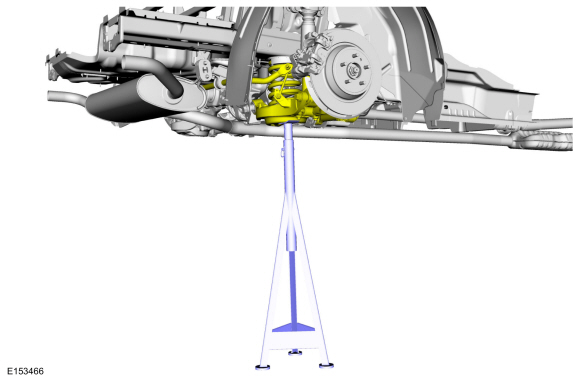
Raise suspension to curb height.
Use the General Equipment: Vehicle/Axle Stands
 |
-
NOTICE: Tighten the suspension bushing fasteners with the suspension loaded or with the weight of the vehicle resting on the wheels and tires, otherwise incorrect clamp load and bushing damage may occur.
-
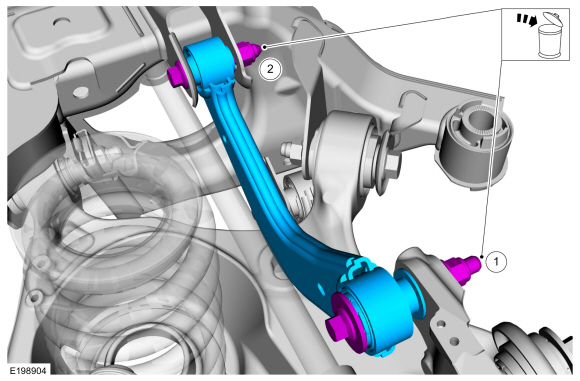
Remove and discard the upper arm-to-wheel knuckle bolt and nut.
Torque: 76 lb.ft (103 Nm)
-
Remove and discard the upper arm-to-frame bolt and nut and remove the upper arm.
Torque: 85 lb.ft (115 Nm)
-
Remove and discard the upper arm-to-wheel knuckle bolt and nut.
 |
Installation
-
To install, reverse the removal procedure.
-
Check and if necessary adjust rear camber.
Refer to: Rear Camber Adjustment (204-00 Suspension System - General Information, General Procedures).
 Toe Link. Removal and Installation
Special Tool(s) /
General Equipment
Vehicle/Axle Stands
Removal
NOTICE:
Suspension fasteners are critical parts that affect the
performance of vital components and systems...
 Wheel Bearing and Wheel Hub - AWD. Removal and Installation
Special Tool(s) /
General Equipment
205-D070
(D93P-1175-B)
Remover, Front Wheel Hub
Removal
NOTICE:
Suspension fasteners are critical parts that affect the
performance of vital components and systems...
Other information:
Lincoln Nautilus 2018-2026 Service Manual: Horn. Diagnosis and Testing
DTC Chart(s) DTC Chart: Horn Diagnostics in this manual assume a certain skill level and knowledge of Ford-specific diagnostic practices. REFER to: Diagnostic Methods (100-00 General Information, Description and Operation). Body Control Module (BCM) DTC Chart DTC Description Actions B1323:11 Horn Switch: Circuit S..
Lincoln Nautilus 2018-2026 Owners Manual: Connecting a Trailer Precautions
WARNING: Do not adjust the spring bars so that your vehicle's rear bumper is higher than before attaching the trailer. Doing so will defeat the function of the weight-distributing hitch, which may cause unpredictable handling, and could result in serious personal injury. Do not tow a trailer until you drive your vehicle at least 1,000 mi (1,600 km). Do not use a hitch that either clamps ont..
Categories
- Manuals Home
- 1st Generation Nautilus Owners Manual
- 1st Generation Nautilus Service Manual
- Locating the Pre-Collision Assist Sensors
- Replacing the Rear Wiper Blades
- Opening and Closing the Hood
- New on site
- Most important about car
Parking Aid Indicators. Parking Aids – Troubleshooting
Parking Aid Indicators
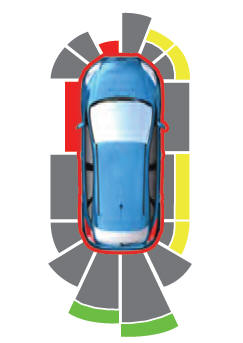
The system provides object distance indication through the information and entertainment display.
As the distance to the object decreases, the indicator waves and the lines move toward the vehicle icon. If there is no object detected, the distance indicator lines are grey.